


Derü mozdony

A Közlekedési Múzeum vasúti modell gyűjteményének legértékesebb műtárgya a Derű, amelyet 1845. és 1847. között készített Nagy Lajos és Nagy Gergely.
A Mozgásban - a Hídember gépei című kiállításunk 2010 szeptembere és 2011 decembere között volt látható
Duna mappáció

A Duna és a Tisza szabályozásának műszaki alapjait a 19. század első felében teremtették meg, elsősorban a minden korábbinál részletesebb vízrajzi térképek elkészítésével.
A Mozgásban - a Hídember gépei című kiállításunk 2010 szeptembere és 2011 decembere között volt látható.
Járgány

Vidats János ekegyára azzal tűnt ki kortársai közül, hogy pesti üzemében előbb lójárgány, majd alig pár év elteltével gőzmasina hajtotta a gépeket.
A lójárgány a Mozgásban - a Hídember gépei című kiállításunkban 2010 szeptembere és 2011 decembere között volt látható
A Lánchíd alapkőletétele
 A Lánchíd a magyar Duna-szakasz első állandó hídja volt. Az építkezés 1839-ben kezdődött meg. A pesti hídfőnél a hídláncokat befogadó lánckamrában helyezték el azépítmény alapkövét. Az előkelőségek díszes vakolókanalat használtak.
Ez a tárgy is látható volt a Mozgásban - a Hídember gépei című kiállításunkon, amely 2010 szeptembere és 2011 decembere között volt látható
Lebegővasút

1827-ben kezdődött a magyar vasút története egy különleges szerkezettel, a Pestről Kőbányáig vezető lóvontatású függővasúttal.
A Mozgásban - a Hídember gépei című kiállításunk 2010 szeptembere és 2011 decembere között volt látható.
A vasút egy 8 méteres rekonstruált szakasza jelenleg az állandó kiállításban kipróbálható.

A Kisfaludy - a Balaton első gőzhajója.

A Kisfaludy - a Balaton első gőzhajója.
A Mozgásban - a Hídember gépei című kiállítás 2010 szeptembere és 2011 decembere között volt látható.
A Lánchíd alapkőletétele

A Lánchíd alapkőletétele, ahol megjelent mindenki aki számított. A Mozgásban - a Hídember gépei című kiállításban felépítettük az alapkő letételtének jelenetét. A kiállítás 2010 szeptembere és 2011 decembere között volt látható.


Services
| Computers behind the Iron Curtain |
|
Hungary: Computers behind the Iron Curtain Written by Gábor Képes
After the 1956 Revolution,in People’s Republic of Hungary Stalinist dictatorship was followed by a political system that was ready for consolidation and opened towards the West. For this reason Hungary was sometimes called the ’happiest barracks of the Soviet camp’. Hungarian computer technology was both connected to the initiatives of the Eastern bloc countries, and also hurriedly following the West at the same time. By 1989 there were approximately 100,000 computers working in the country, and its computer technology was typically colourful and full of unique solutions.
1. Heyday of Cybernetics in Hungary Every modern digital computer in the world is set up on the principles (principle of the stored program) described by the Hungarian-born American mathematician, John von Neumann (1903-1957). Neumann made his own concept available for the whole world.The history of modern computer science started in the 1940s and 50s - while the Second World War was ending and the Cold War was starting. Computer research began in the Soviet bloc as well, although in the era of Stalinism cybernetics was considered a “dangerous civil pseudoscience”. This point of view slowly changed starting in the second half of the 50’s. By the end of the 1950s the first working Hungarian computers began to appear, which also inspired and influenced professors to teach cybernetics (László Kalmár in Szeged, László Kozma in Budapest). With further development in the Soviet plans, the first Hungarian electronic computer (M-3) was built by developing further on a Soviet plan – and a high school teacher called Mihály Kovács introduced it to his pupils. The Hungarian Central Statistical Office also used modern computers and punch-card data processing systems. The company IBM was even allowed to be present in the country to help them set up these systems. There were exactly five computers in operation in Hungary by the year 1960. At the beginning of the 1960s the first producers of Hungarian cybernetics introduced themselves and their products at the Budapest Expo to the inquiring and questioning audience. Computer science as a discipline had finally started to take shape behind the ‘Iron Curtain’ in the form of bigger universities departments and research institutes that would fulfil political and economic needs.
Professor Kozma’s relay-system computer
Professor Kozma’s computer was the birth of computer technology in Hungary. The machine was offered by the professor himself to the predecessor of the Hungarian Museum for Science, Technology and Transport. Since then it has been preserved in the Study-store of the Museum. For Hungarian people it has similar value to Konrad Zuse’s computers in Deutsches Museum has for German visitors.
Magnetic drum of the first Hungarian electronic computer
The research team employed several young engineers in their twenties; they brought around these young engineers and started operating the machine in a creative way. Tungsram electron tubes were used in the M-3. Tungsram was a world-famous Hungarian electric bulb factory, widely known even in the first half of the 20th century. The capacity of the first magnetic drum of the M-3 was 1 kiloword (cca. 4 kilobytes). The computer has several magnetic drums and – under the leadership of a young colleague, Győző Kovács – magnetic drum controls were made for the computer, which was later also used for one of the first Romanian computers called MECIPT-1. M-3 worked in Budapest, then it was moved to the University of Szeged (to the legendary László Kalmár, pioneering figure in educating programming mathematicians), where (in 1968) it was discarded and its part were given out to the professorates. Some if its pieces have been successfully preserved as a memento.
The first Hungarian “artificial animal”: Katicabogár (Ladybird)
Animal models like this are basically robots, the robotic vacuum-cleaners and military minesweeper robots were its descendants as well. The original Ladybird can be seen in Szeged – where a permanent exhibition on information technology is to be opened –, the fully operational copy of the machine, made by its original designer, can be seen in the Study-store of our museum in Budapest.
This copy of the URAL-2 was produced and delivered to our country in 1962, and it was used by a computing centre in the building industry. One of the curiosities of the computer is that is used film tape based punch card technology. On the punched tape the binary code is well discernible; the computing engineers of the time could read the program using only their very eyes. This is the only remaining copy of the URAL-2 in Hungary. The object has an accentuated place in the project called Inventing Europe.
Cybernetic building kit – for pupils!
At that time the pupils from ecclesiastic school were rather negatively discriminated, even their further education proved to be more problematic. That’s why many of his students emigrated to the West. However, grateful students living in the West sent him catalogues of articles of teaching: these and other up-to-date literature helped Mihály Kovács to establish the country’s best repository of educational objects. He constructed cybernetic toys with his students using the discarded telephone exchange components of the Hungarian Post Office. E.g., playing cards machine, a mathematical problem solving machine, or a labyrinth game similar to Claude Shannon’s artificial mouse. In 1967 with one of his students, Ferenc Woynarovich designed a cybernetic building kit; a small firm called Homecraft Cooperation of Buda District and started producing it. Mikromat, this simple computer model, containing four relays, was the country’s first computer technology product that could be bought in a shop by any young people.
2. The Age of Transistor: Hungarian Computer Industry Slowly Vivifies. In the second half of the 1960s there were thousands of professional young engineers and programmers working on computers in Hungary. By 1970, one hundred and forty-seven (147) computers had been put into operation. While Eastern computers were among them (Soviet, Polish etc.), a significant number were imported from the West. Hungarian industries also responded to the appearance of this newborn science: transistorized computers were made in the Electronic Measuring Instruments Factory (Elektronikus Mérőkészülékek Gyára, EMG) and in the Central Physical Research Institute (Központi Fizikai Kutatóintézet, KFKI) also. The computers of the era emulated the methods of punch-card technology in many aspects but they were not usually compatible with each other. Around this time, there was no unified standard of computers even among countries in the East. It was in this exciting period was when Árpád Klatsmányi, an EMG engineer, created and domesticated semi-conducting technology in Hungary. The first Hungarian transistorized computers were introduced at the professional exhibition in the town of Esztergom in the year 1968. The First Hungarian transistorized calculator
It was the first Hungarian transistorized calculator. The display of the machine is composed of digitron tubes. The company EMG produced (under the brand name Hunor) calculators and machine-tool controllers even in the 1980s the brand name Hunor. The Hunor family of calculators also had pocket and programmable calculators. In the 1970’s and 80’s, using integrated circuit technology, another Hungarian company, the Association of Telecommunications (HT) started manufacturing calculators: these were licensed copies from foreign manufacturers, mainly from Texas Instruments products. The Hungarian Museum for Science, Technology and Transport owns a copy of the Hunor-131 and several of its successors.
External keyboard for the Hunor
In the beginning of the 70’s he fitted a lot of peripherals to the computers which was used successfully in foreign countries. These peripherals were produced in Western countries. For instance the mechanical part of high-speed puncturing-machine that can be seen in this catalogue was of the type made in Sweden, FACIT PE-1501.
3. The Unitary Computer System In 1968 the Soviet Union’s Premiere, Aleksey Nikolayevich Kosigin (1904-1980), sent a letter to the leaders of the socialist countries proposing a new collaboration system. This was the so-called Kosigin Letter. At the suggestion of Kosigin, the European COMECON-countries agreed to develop a conjoined computer family. They created a joint schedule for developing products in what was called the Unitary Computer System, as well as an Intergovernmental Committee of Computer Technology to control the tasks. One advantage of the Unitary Computer System (EC, based the Cyrillic initials for the phrase Unified System) was that it would put an end to the total chaos of the different state-funded programmes. It became possible for hardware-and software products made by different manufacturers to be used outside the borders of the given country as well. The main goal was to cut back the time-lag in development compared to Western countries. The model was in the IBM Company 360 family. The Soviet Union had always demanded a leading and controlling role in the Unified System right from the very beginning. The Union wanted to produce the most powerful products of military significance. There was an important production of magnetic data storage devices in Bulgaria under the brand name IZOT, while the other Eastern countries took their significant parts within the Unitary Computer System. In Hungary the manufacturers VIDEOTON (Székesfehérvár) had a primarily military profile, but also gained experience in producing consumer electronics. It was this company that undertook most of the computer production. The company Videoton produced display terminals, printers, other peripherals and full computers in the settings of the Unified System.
It’s a Videoton – and yet, it isn’t. (VT 1010B object)
Meanwhile, VT (Videoton) became the ace of Hungarian computer industry; a steady infrastructure was being built up in a very short time at the company which had significant military potential. Our copy – the Hungarian version of the CII 10010 – was already known as Videoton 1010B. It showed up in the first half of the 1970’s; very few of its copies are known about.
The most popular Hungarian minicomputer: Videoton R-10
Mass production of the R-10 (which was spread countrywide) started in the mid-1970s. Building up the R-10 as an on-line data-collecting system was very beneficial. The peripheral low-capacity was set to (Min. 4, max. 32 kilowords of 16-bit words) minicomputer of TTL circuits with display terminals, punch-card and pinched-tape units plus an 800 kilobyte SAGEM fixed disk and later even an 8“ floppy drive. It was a 16-bit machine, with a ROM-memory of 8 kilobytes. The R-10 (which was produced till the early 1980s) was introduced with great success in the Soviet Union and other COMECON-countries, as well. Being a low-category and (at that time) relatively cheap computer it functioned splendidly as a ’satellite‘ machine for the bigger machines of the Unitary Computer System. This machine made up a significant proportion of the over one thousand computers used in Hungary by the early 1980s.
The terminal could be used in German, Russian, English and Hungarian surroundings. According to the tradition of the Unitary Computer System, the type was given an international standard type mark (EC-7168).
(VDN-52500 terminal in the Study-store of the Museum)
The company’s aspired to produce terminals that can be used with the computer types made by two great American manufacturers: IBM and DEC. The products of the VDN-series were available in Eastern Europe in a significant quantity, and also with the possibility to export to Western Europe.
Printers from the East. (Videoton 27090 line printer)
According to the memory of Gábor Révész, a former worker of Videoton company, this type was based on the American Data Products licence, then later this licence was passed on to the Soviet Union, where line printers were made in the town of Kazan.
4. Computer Industry in the People’s Republic During the 1970s and 1980s a number of Hungarian companies took an active part in manufacturing computer peripherals. In the 1970s the most typical feature of the Hungarian industry was the system of state-owned companies, while in the 1980s new economical formations began to emerge as forerunners of capitalism. The country was opened to international financial and economical cooperation. Although Hungary seemed to go its own way, its Western diplomatic and economic connections were most welcome to the Soviet Union. This was especially the case in the sphere of computer technology, where Hungarian intercession allowed the Soviet Union to circumvent the prohibition of the capitalist world – thus seize modern technology. The bureaucratic approach of companies from state socialist countries was typical for the manufacturers of the era. Bureaucracy created great difficulties for them in keeping the pace in this fast-developing branch of industry. In spite of this, a number of companies developed and manufactured marketable products for years. The computer of the Research Institute
The Central Research Institute of Physics were “cloning” the American DEC company’s PDP computer family until the late sixties of the political regime changes – this product was known as Analyzer of Stored Programs (Tárolt Programú Analizátor = TPA). However, this TPA family had an own development, too: the TPA-70, which had integrated circuits and which was constructed around 1970-72 by János Bogdány and his colleagues.
Could have been a world success… (MCD-1)
Marcell Jánosi worked as a chief constructor of magnetic technology at the Budapest Radio-technology Factory. Among other things, He designed reel-to-reel tape recorders and later designed cassette tape recorders. His co operational work was to design data tape recorders for the Swedish Luxor ABC-80 computers. The successful cooperation had a spectacular result: the ABC-80 arrived in Hungary at the very beginning of the 80’s bearing the name BRG ABC-80.
Marcell Jánosi continued working as an engineer after the MCD-1: his last successful project was a miniature engine designed and made for LEGO games.
Manufacturer of magnetic disks MOM was the titan of the Hungarian instrument industry. Many people found it symbolic that shortly after the politico/economical regime changed, the MOM factory was demolished – in its place a shopping mall was built under the name “MOM Park” at the turn of the millennium.
Rosie, the electronic secretary
5. “Computing is for everyone – computers for everyone!” In the 1980s, tens of thousands of computers (by modest estimate) were owned by private persons in Hungary. There were far fewer in workplaces. The developed, capitalist countries themselves discouraged exporting professional computers to Hungary, for fear that these high-technology developments would be used for military purposes. The Coordinating Committee for Multilateral Export Controls (COCOM) blocked the export of computer equipment – which was also disadvantageous even for profit-oriented Western companies and manufacturers. Purchasing cheaper home computers abroad and bringing them back into Hungary was made problematic by the inflexibility of the Hungarian customs regulations. Therefore smuggling computers (and other durable goods) became nationwide practice at the time. People did not even consider this act to be immoral: it was more like part of the struggle against the inflexibility of the political system. Travellers on a short holiday or a delegation to Vienna for example (or any other Western-European city) would smuggle some computers home in their Trabant cars. Between 1984 and 1987 different groups of users emerged around the Commodore VIC-20, Commodore 64, Sinclair ZX-81, Sinclair ZX Spectrum and other types of home computers. Software supply was also a problem to be solved. For the average user the solution was mass-copying the legal software that appeared in Hungary every now and then. The next step in copyright infringement was swapping these programs – this activity was allowed and even encouraged – in cultural centres or canteens. Propagation of computer culture was helped by the television course TV-BASIC broadcast by the Hungarian Television, along with the press and professional exhibitions. The latter had the slogan: “Computing is for everyone - computers for everyone”. Hungarian industry also tried to keep pace, and soon their own models of personal computer began to appear.
The game was also called TV-tennis. It could be controlled by very simple potentiometers. Of course it was counterfeited in Hungary. In our picture one can see one game by Videoton (in green colour) and another one by HT (in yellow colour). Because one of the trade journals even published the circuit diagram of this game, home-built copies are also known from that era. The real consoles with changeable tapes (like Nintendo) spread in the country very much later, in the 90’s. The tv-gamers who started to get acquainted with this experience of “interactive tellying” usually bought cheaper home computers as a second step instead of real game consoles. These TV-games had a great popularity for another peculiar reason: the Hungarian Television held a so-called broadcast break on Mondays in the 80’s in Hungary. So having nothing to watch on the television set, gaming was the main role.
However, their machine did not correspond to all the requirements of the competition. It was just a licensed version of the EACA Video Genie from Hong Kong, which was also a clone of the TRS-80 (determinant machine in the end of the 70’s in the United States, along with the Commodore PET and the Apple II). By the time it arrived to Hungarian schools, if we consider it from first version, TRS-80 as a basis, it had a time-lag of at least 5 or 6 years compared to the school computers in the western countries. The first computer had a RAM memory of 16 kilobytes, then 64 kilobytes – and it did have definite advantages: the keyboard resembled that of the typewriter, its structure was massive, and the machine had a built-in tape recorder. HT computer could well cope with the rush of school children. Its primary educational purpose was teaching standard BASIC language, because at that time all home and school computers used that. The person who developed BASIC, John Kemeny, was born as Kemény János in Budapest in 1926). In the attached picture one can see the HT-1080Z/64 computer next to two Western types (that were very popular even in Hungary): the British Sinclair ZX-81 and the American Commodore VC-20 – which was well-known in the Federal Republic of Germany under the name of VolksComputer) in the Hungarian Museum for Science, Technology and Transport, 2010, seasonal exhibition).
Primo – the forerunner (Primo computer family)
According to contemporary reports, quality control took place ’on kitchen tables‘. In the 1980s, the first seeds of the entrepreneurial sphere sprang up in Hungary. These involved several mutual organisations founded by different representatives of economic and scientific life. The ’auxiliary works‘ of agricultural production comradeships became the active participants. The Primo was built around the microprocessor of the U880, an East-German clone of the American Zilog Z-80. For the first series they had to use Hungarian and Eastern products, from used plastics to electronic building units, for construction. Primo was released with a RAM memory of 16, 32 and 48 kilobytes; its graphics were monochrome with a resolution of 256*192. Its suggested price was 10,000 forint (about twice as much as an average monthly salary at the time), finally though it was released at a slightly higher price. Its first version included a home-designed, flat touch-button keyboard (according to contemporaries, its keys needed not to be pressed but ’massaged‘). There was also a short-lived B-version with push-buttons. In our last picture (bottom, right) the newer version, the Pro-Primo can be seen: it should have had colour display, but this type – made for the secondary school computer teacher – remained only a prototype, because in the second half of the 1980s the Hungarian schools decided to buy Commodore-16, 116, plus/4 computers instead, sold by the Hungarian company Novotrade.
For a computer you need games, too
Game programs often appeared in printed magazines as program lists (typing them were problematic because of the regular errata, resulting in disappointing error messages when running these programs). In most cases copied programs were stored (although it was illegal Hungarian authorities showed some indifference): “copy-parties” for copying and swapping illegal programs weren’t unusual phenomena even in the beginning of the 90’s. It was also a significant problem that one could use far less software stock for Hungarian computers (e. e. Primo, Homelab, Videoton TV Computer) than for those made in the Western countries. The solution was by copying and converting the programs. The tape cover that can be seen here was preserved for the museum by the director of the closed printing house. This game was a legally distributed copy of Manic Miner, programmed by the British Matthew Smith (1966- ). Manic Miner was a world-famous game program; its Hungarian version was converted to Primo and was given the title “Vili a bányász” (Miner Willy).
6. Business computers – but where is the business Between bigger computers (used in computer centres, universities or companies) and cheap home computers there were several categories that ended for office or business use. Under the conditions of a socialist state and even in the 1980s Many economic players appeared that needed the benefits of modern computers. Printing-houses, smaller companies or administration offices also had to be provided with computers. The IBM PC (introduced on 12th August, 1981) is the most significant example of a professional personal computer for business. In the middle of the 1980s this kind of technology was also not unknown to Hungarians. The real burst in information technology came right after the change of economical/political regime (1989-90). Representatives of international companies appeared en masse during this period and trade restrictions disappeared. This also made creative “cloning” of Western technology pointless. New innovations using the country’s own components and potential also had to pass the test of international competition. Thanks to the development in Hungarian information technology which had been taking place since the end of the 1950s, behind the ‘Iron Curtain‘, Hungarian developers were not taken unaware by these new challenges. The arrival of cellular phone services (NMT, later GSM networks) and the World Wide Web spreading worldwide – is another story.
Proper’s computers got their unusual brown housing, with vacuum-formed elements: the machine suited the atmosphere of socialist offices very well. Similarly designed dot-matrix printers were also made for this computer type (they were the MP-80). The price of the Proper-16 was 420,000 forints in February, 1985 (the cheapest configuration), while the ultimate, most complete configuration was sold for more than 1,300,000 forints. (Leasing cost was 30-42,000 forints per month) The average monthly salary was approximately 6,000 forints at that time. One can imagine that these computers weren’t intended to be used by the average people…
Gábor Faix constructor with the Proper Leading constructor of the first Hungarian IBM PC clone was Gábor Faix. He can legitimately be proud of his work, since his task was not by far to build up a “PC house” by using ready-made elements. First, he had to get acquainted with the original PC, and then had to recognise the documentation published by IBM to the collection of computer parts available in the East.
A keyboard (made in Hungary) and a switch-gear power supply unit (developed in Hungary) was also made for the machine. In the year 2011 the Hungarian Museum for Science, Technology and Transport commemorated the 30th birthday of the IBM PC with a seasonal exhibition (DOStalgia). The photo of Gábor Faix and his decorous was taken on the professional day of this exhibition.
From the middle of the 80’s other manufacturers joined SZKI in the competition to clone IBM PCs (Device Technology Co. /Műszertechnika/ or the reputed Videoton company can be mentioned here as an example), and in most cases they also chose to assemble cheap computer houses and cards. This solution was called “overbolstering”; it made the inrush of modern technology easier.
Photo plotter – of European standard
Under the leadership of the Head of the Department Dr. Károly Vörös, the instrument (designed by Szabolcs Tőkés, dr. Iván Kas, András Palotási, Frigyes Zalán, László Csipka) was introduced in 1984 at the Budapest International Expo. In the year of its introduction the LG-1 with its resolution of 1016 dpi was amongst the first laser photo plotters in Europe, its micro-electronic and laser-based approaches did not fall behind the Western standards. The LG-1 won the Grand Prix five years later and at the last (1989) Leipzig Expo, too. The designing process went according to the standards of the era, with the needed careful pre-planning of the quantity of the parts, and the aim to use autocratically Hungarian or Eastern parts, whenever possible. It could work in configuration with IBM PC XT/AT personal computers or as an autonomic system with magnetic taped control system alike. Its working principles and its build-up were based on licenses already accepted in more than 10 countries. It can be perfectly used for making master- and werkfilms of printed circuits, their documentation, for phototypesetting, cartographical purposes, for processing aerial- and space photographs, for displaying medical pictures and for many other purposes, mainly for those supported by the CAD program packages. The Warsaw Organization of Friendship, Cooperation, and Mutual Assistance Treaty (commonly referred to as Warsaw Pact) had intended to use the LG-1 for cartographical purposes, but before its actual launching the Warsaw Pact had bursted up.
After the Lasergraph LG-1 the next type called LG-2 was introduced (resolution: 2032 dpi), and it received the gold medal at the Budapest International Expo in 1990. The iron curtain in its state of nature did not divide the East and the West anymore, but the effects of the isolation of the Eastern countries could still be felt. In the nineties the former „Eastern“countries counted as new markets for most of the Western companies. Hungarian developments had a lot of difficulties to penetrate into the Western countries; it was rather problematic due to the economical oddities. A typical example: the German company that sold the LG-1 and the LG-2 photo plotters bought them for a price of 45-65,000 German marks and would pass the apparatus on for twice as much as the net cost.
The history of the LaserGraph is basically a success story, which continued well after the changing of the regime, for instance its version from 1999 was an imagesetter used for making quasi-holographic prints. This success story had its barriers in the world market though, since the multinational companies (that had huge assembly halls and computerised measuring stations) did not consider the tiny labs of the enthusiastic, lifelong-researching engineers equal to theirs. However, it’s a fond addition to the story that once – in a topic about the LaserGraph – a foreign paper nicknamed Hungarian computer culture „the Paprikatech Valley” (a humorous allusion with the Silicon Valley). It wasn’t an easy adventure: to live up to the expectations of the East – and, at the same time, to try and reach the high standards of the West.
Gábor Képes is Head of the Department of Technological Also participated in the project are: Dr. Mária Bezzeg, Ph.D.,(Head of Department of Documentation in HMSTT) Museologists: Csaba Alvári, (Catalogue Store), Ottó Kovács (Repertory) Photographer: Szilvia Rudó Translator: Péter Kollárik |

 The Cybernetics Research Team of The Hungarian Academy of Sciences started the construction of their electronic computer at the end of the 50’s; according to a contemporary newspaper report the computer was put into operation on 21
 The University of Szeged is the cradle of Hungarian education of cybernetics and mathematics programming. Professor
 In the very beginning of the 60’s Hungary got several URAL-1 and URAL-2 electron tube computers from the Soviet Union too. This was the era when the first computer centres of the country were established.
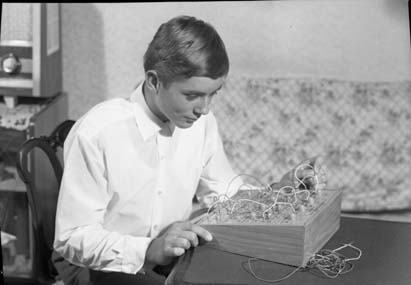 At the end of the 1950’s a Piarist monk, also a teacher of physics,
 In the 1960s, computers still needed air-conditioned rooms, dust-free environment and thier own technical crew. At the same time, however, the first table-top calculators also started to emerge in Hungary. In 1964-65 the Hunor-131 appeared, designed by
 Árpád Klatsmányi introduced a design of his own, the transistorized computer called the EMG-830. He designed this computer between 1965 and 1968; there were both a process-controlled and a conduct version of it. The computer consisted of silicone based units, with an up-to-date module system and line pattern. Having been developed in Hungary, it was used for an amount of purposes, from technical-scientific calculations to payment statistics.

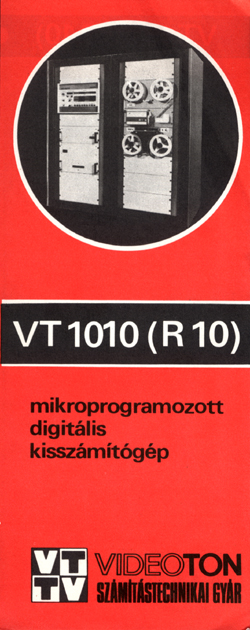 The Hungarian industry adopted the French MITRA-15 compact computer, and also based the the R-10 on a French licence. The development of the MITRA-15 had been followed closely by the Computer Science Coordination Institute from its very beginning in 1971, and whenever they travelled to France in subsequent years.
 The company Videoton became a known and acknowledged manufacturer of computer peripherals. The line of its display terminals started with the VT-340 in the first half of the 1970’s. It could be used both as a console and as a terminal. Its display size is 11", its useable image ratio is 200*150 mm. It was suitable for displaying 80 characters in 16 lines. Its character set was of ASCII code system, containing 26 Latin capital letters, 10 digits, 27 characters and 31 Cyrillic capital letters (optional).
 Videoton went on producing terminals even in the 80’s. With the help of a well known industrial designers the company’s experts work earned them an Award for Quality.
 From the 1970’s Videoton produced printers as well. This copy is an early piece: made for the 1010B computer. The drumlike line printer had carved English capital letters and numbers, with a drum of 80 or 132 columns. The printer printed on folder paper (leporello), which was characteristic paraphernalia in computer centres.
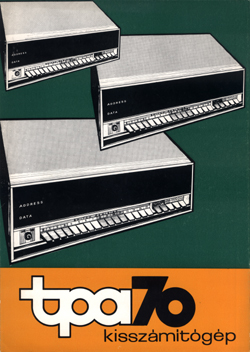 The Central Research Institute of Physics (KFKI) is a characteristic institution. It’s also very productive. It gathers scientists from numerous areas of physics. It was a city within the city, or better to say: over the city, for its multi-premises, closed world protected by guards, was built in the vicinity of Budapest, in the forest-clad area of Csillebérc. The tranquillity (quietness) of the park provided peaceful circumstances for the researchers – and adequate protection for nuclear researches.
 This object is displayed as an outstanding subject of Inventing Europe project. It is a cassette- based floppy and an achievement for Budapest Radio-technology Factory (Budapesti Rádiótechnikai Gyár, BRG). Its designer,
 The greatest adventure in Marcell Jánosi’s life was the MCD-1 floppy, which was attempted to be sold in Western Europe (for ZX Spectrum computers among others) in spite of the suspicious and rather clumsy policy of the producing company. This experiment was a late one; the expectations of the factory were much too high.
 Among the manufacturers of the peripherals in socialist Hungary one manufacturer stands out: the famed Hungarian Optic Works (Magyar Optikai Művek, MOM). Its predecessor company was founded already in 1876. Here they had a sterile laboratory suitable for producing magnetic disks, particularly hard drivesand floppy disks. The company made 5.25” and 8” floppy drives as well.
 The need for special offices targets increased in the eighties, computers for one special purpose were made. The manufacturer of the word-processing computer called Rosytext was Rolitron firm which was co-founded by
 At that time the ante-room of using computers were the game consoles like Pong. The world’s first TV-game was introduced by
 In the first half of the 80’s it became clear that computers had be used in public education, to a greater extent than before. The Ministry of Culture called for a tender to develop and produce school computers – machines that can be used in teaching computer sciences. With a great lobby-force the tender was finally won by the Association of Telecommunications – and their computer called HT-1080/Z.
 The first Hungarian commercial (i.e. available to individuals) computer was the Primo, introduced in 1984, which was designed by the colleagues of the Computer Science and Automation Research Institute of the Hungarian Academy of Sciences (MTA SZTAKI). But production took place in a little agricultural organisation, ’New Life‘ Farmers’ Co-operative, near the village of Sárisáp. About 9,000 computers were constructed there under crude circumstances.
 Most Hungarian computer owners used tape recorders for data storage for their home computers. Mainly, the Hungarian affordable BRG MK-27 and MK-29 types
 Hungary’s first IBM PC-clone was also one of Europe’s first IBM PC/XT clone. It was produced around 1982 at the Coordination Institute for Computer Sciences (Számítástechnikai Koordinációs Intézet, SZKI). The Institute founded its own branch for manufacturing personal computers (Sci-L. PCs working in CP/M operating systems (M08X, Proper-8) and PCs compatible with MS-DOS were both produced there.
 He fitted out the memory modules of bigger capacity properly. He made eight enlarging sockets instead of the usual four. A number of other modifications (like different plug-ins) bode that Proper-16 was going to follow the footsteps of the IBM PC, at the same time a unique computer in a treading on to meet the exigencies and challenges of the rousing Hungarian market.
 The SZKI Company (Coordination Institute for Computer Sciences) continued to introduce and promote the style of the IBM PC in Hungary. Later constructions (made in the middle and in the second half of the 80’s) showed that it was much easier to get parts and pieces from the Far East (or from other, internationally panned mass-producing companies), comparable
 The Lasergraph LG-1 photo plotter (originally developed in
 Museology. Since 2004 he has been a curator of the computer science collection of the Hungarian Museum for Science and Technology, and then from 2009 in the successor institute: Hungarian Museum for Science, Technology and Transport. He graduated in 2004 from Eötvös Loránd University, Faculty of Humanities (ELTE BTK). He was Professor Iván Horváth’s student in information technology in the humanities, and was commissioned as an executive to the ELTE BTK Library Science Institute.
 Az oldal tetejére
Addresses


Connections


Gallery


